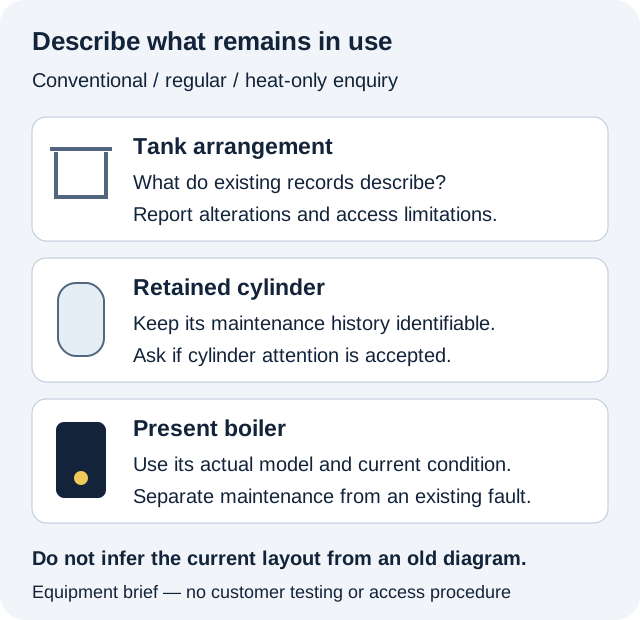
Enquire about maintenance of an existing regular or heat-only boiler with GasSafety 247, based in Nottingham. This service request identifies the boiler in its current arrangement, including any retained cylinder, tanks and external equipment relevant to the proposed work. It suits a homeowner or authorised property manager arranging appliance maintenance, and a landlord who needs a clearly separated maintenance instruction. Send the product details and postcode through Contact, explaining whether the boiler is operating normally or whether a particular concern needs assessment. Request a proposal that states which equipment is included, how access will be handled and what maintenance findings will be recorded.
Acceptance depends on the actual installation and the appropriate work competence.
Conventional Boiler Service: detailed service scope, booking and next steps
Explore this page
01
Commission the existing heat-only appliance accurately
Use regular, conventional and heat-only descriptions without assuming a model
These descriptions commonly refer to the same general boiler category. Worcester Bosch's regular-boiler explanation describes an arrangement with a separate hot-water cylinder and cold-water tank. That description helps a customer frame an enquiry; it does not identify every installation or establish how a property has subsequently been altered. Give the product name from retained documents and explain which equipment remains connected as far as the records show. A provider should accept the maintenance request against the appliance actually present. If a sales brochure, old invoice and current appliance label disagree, preserve that uncertainty instead of selecting a convenient name.
The purchase is for professional attention to your boiler, with its actual configuration considered, rather than a generic service of everything ever described as a conventional heating system.
Keep the boiler category separate from appliance age and condition
A conventional boiler should not be described as obsolete, unsafe or beyond repair solely because of its category. Conversely, a newer-looking appliance does not prove that all retained equipment is suitable or maintained. State any known product date, last maintenance and current professional recommendation. The provider can explain the appropriate maintenance scope and any need for further assessment. If a replacement decision is already being considered, mention it as a separate objective. This allows a proposal for present maintenance to be assessed without implying that the appointment guarantees a remaining life expectancy or automatically recommends a new system.
A useful commercial enquiry makes the customer’s immediate task clear: maintain the existing appliance, investigate a reported problem, or obtain a separate replacement assessment.
Identify whether there is a back boiler or another different appliance arrangement
Do not choose this page merely because an appliance is old or heats a cylinder. If the property records describe a back boiler or another arrangement, include that description before requesting attendance. The back-boiler service route exists separately so the enquiry can be matched to the actual equipment and appropriate competence. A provider should not accept a conventional-boiler appointment based on an assumption that every older gas appliance has the same maintenance process. Photos can assist where safely obtainable, but they cannot replace product identification or site assessment.
The customer should not uncover hidden equipment to supply them. Describing uncertainty correctly lets the provider explain whether the requested work can be accepted and whether another maintenance or assessment instruction is more appropriate.
02
Include the retained tanks and cylinder in the equipment brief
Treat the known tank arrangement as relevant context, not a diagnosis
Energy Saving Trust's heat-only boiler explanation describes the additional header tanks associated with a typical arrangement, commonly positioned in a loft. Tell the provider what your existing documents describe and whether work has changed that arrangement. Do not assume the familiar picture of two tanks applies unchanged to your property. A loft conversion, equipment replacement or alteration may mean a professional needs to establish what remains in use. Customers do not need to enter the loft, lift tank covers or trace pipes for this enquiry.
If tank attention is being requested, name that task and ask whether the proposed attendance includes it. The provider can distinguish appliance maintenance from examining retained storage or associated equipment, avoiding an unexplained gap between what the customer thought was covered and what was actually commissioned.
Make a cylinder requirement an explicit additional purchase
A boiler service should not be presumed to maintain a separate hot-water cylinder. If you need attention to that asset, state the product details, last available report and reason for the request. Ask what work is accepted for the cylinder’s actual type and who is responsible for its completion. The cylinder services category provides the relevant enquiry path. A coordinated appointment may be proposed, but its convenience does not remove the distinction between the boiler and the stored-water equipment. This matters particularly where the customer’s concern is hot-water availability while the boiler appears to provide room heating.
Ask whether the maintenance quotation addresses that concern or leaves an additional assessment to be commissioned. The resulting records should identify each asset actually attended to.
Preserve the difference between an active component and abandoned equipment
Retained paperwork or visible equipment can relate to an arrangement no longer used. If a previous project disconnected or replaced a tank, cylinder or control, share the completion information you have. Do not ask the maintenance provider to rely on a guess that an old item is inactive, and do not reconnect or operate it yourself to find out. The current appliance service should be accepted with relevant configuration uncertainty visible. Where confirmation needs a broader survey, request that as a defined task. A service record can then address the present boiler while recording a remaining identification or condition issue separately.
This avoids carrying obsolete equipment descriptions into a new history, or accidentally presenting a boiler service as confirmation of every disconnection and alteration made elsewhere in the property.
03
Explain circulation and stored-water concerns by what has been observed
Give a room-heating report without selecting a replacement part
If some radiators are slow, the whole house has lost heat, or the behaviour changed after earlier work, describe that pattern and its timing. Mention what has already been professionally assessed. A maintenance enquiry should not prescribe a pump, valve or cleaning process on the basis of a symptom alone. An external component or connected circuit may need its own investigation; the provider must assess the actual cause and appropriate scope. Ask whether the proposed conventional-boiler service includes attention to the reported concern or whether central heating repair assessment is required.
The commercial distinction is practical: you may want the appliance maintained and a heating problem resolved, but those outcomes must both be accepted rather than inferred from one broad service label.
Report hot-water behaviour in the ordinary household routine
Describe when the household notices the hot-water concern, whether it affects more than one outlet and whether it followed a known installation change. There is no need to create extra demonstrations, operate unfamiliar controls or change settings for the booking. An observation that stored hot water seems insufficient does not determine whether the cause lies with the heat source, controls, storage or delivery arrangement. Ask the provider to explain which assessment you are purchasing. The conventional-boiler maintenance record should not be treated as a promise of stronger water pressure or a larger volume of stored hot water.
If improving demand provision is the objective, make that explicit so the relevant design or suitability assessment is considered separately from routine maintenance of the appliance.
Mention visible water concerns without reaching equipment to investigate
If you have already noticed a drip, staining or another water-related concern in an ordinarily accessible place, tell the provider where and when. Give any earlier report you hold. Do not climb to an external pipe, open a tank or interfere with a fitting to identify the source. The provider should explain whether assessment of the concern is within its proposed work or requires another task. A boiler-maintenance purchase cannot silently include all water-system investigation at the property. Equally, a known concern should not be concealed so that an appointment is booked as routine maintenance of a normally operating installation.
An accurate account lets the professional decide what attendance is suitable and what restrictions or further actions need to be communicated.
04
Protect the maintenance brief when the building has been altered
Describe loft work that may affect retained equipment access
If the loft has been converted, boarded, insulated or reorganised since the last maintenance attendance, explain that fact when relevant to the equipment being commissioned. Do not claim that every Nottingham conventional-boiler property has loft tanks, or that a local housing type determines the installation. The issue is the actual building and its retained equipment. Ask how any access-dependent task will be assessed and whether the provider needs further information before accepting it. Access to the boiler at ground level does not establish safe access to a separately requested loft task.
Customers should not dismantle storage, remove tank insulation or enter an unsafe space to make the booking easier. A proposal should identify the limitation and the suitable responsibility for preparation instead of promising complete system attention regardless of the building’s current condition.
Share later alterations to the cylinder or heating arrangement
A retained conventional boiler can be part of an installation altered over time. Send the information for relevant cylinder replacement, control work, extension heating or other changes that affect the request. Explain which contractor completed them and provide existing completion evidence where you hold it. This is not an instruction for the service provider to approve every previous project at the property. Ask what context the maintenance requires and whether a concern about an alteration needs a separate assessment. An accurate current record should distinguish the maintained boiler from equipment that has its own installation or service history.
The customer then avoids an assumption that routine appliance maintenance retrospectively establishes the suitability of connected work undertaken by other parties.
Keep a proposed conversion separate from maintenance of the retained boiler
If you are considering removal of tanks, a different boiler arrangement or another heating project, describe that as future work. The boiler installation hub provides the relevant route to a separate proposal. Servicing the existing appliance does not establish the design, water provision, compatibility or cost of a conversion. A customer may reasonably want present maintenance while evaluating a later change, but should understand the two purchases and their different records. Ask whether a provider can accept each objective and what information is needed for the project assessment.
Avoid ordering a new arrangement from an assumed standard package before the actual property and retained equipment have been considered by the responsible professional.
05
Buy model-specific maintenance without inventing a universal checklist
Ask the provider to define the work against the identified appliance
The appropriate professional maintenance depends on the actual model, instructions and condition. Ask the proposal to identify the boiler and explain the scope rather than accept a broad list that appears to apply to every conventional appliance. Where a manufacturer’s maintenance requirement prompted the enquiry, provide the relevant document and ask what the provider can undertake. A page about this service does not establish manufacturer authorisation or approval for every model. It also should not instruct customers to open, clean, adjust or test gas equipment.
Your role in the enquiry is to identify the appliance and purpose; the competent professional determines the appropriate procedure. The resulting record should show the work completed or a limitation encountered, rather than rely on attendance alone as evidence of maintenance.
Identify an existing fault before an ordinary service is agreed
Mention error messages, loss of function or a previous restriction accurately. Do not reset or restart equipment merely to make it look normally operating for a planned appointment. The provider may need to propose diagnosis, repair or another appropriate response before ordinary maintenance can be completed. The boiler diagnostics category helps distinguish an investigation from a service purchase. Ask how the reported problem affects the accepted appointment and whether a return task would require separate approval. An ordinary service must not be presented as a fixed-price promise to resolve any component fault found.
If the professional communicates a restriction on use, follow it while further action is arranged.
Keep the professional's evidence distinct from household comfort expectations
A service can address an identified maintenance need without establishing that the entire property will reach every desired temperature or that all outlets will perform differently afterwards. Describe a comfort objective if it is important to your purchase, then ask whether the proposed task addresses it. A room-heating assessment, control change or wider system project may be required and should have its own accepted scope. The maintenance record concerns what was examined or completed on the equipment included. It should not be stretched into a whole-house performance guarantee.
A clear proposal therefore protects both decisions: how to maintain the conventional boiler now and whether any separately assessed work is needed to meet the household’s wider requirements.
06
Arrange access and authorisation for the actual property
Confirm which areas the accepted tasks require
Give the boiler position and describe access to any cylinder or tank included in the request. State who controls entry and whether a locked cupboard or another person’s area creates a dependency. Ask how inability to reach an item will be handled. A completed boiler task and an incomplete connected task should not be reported as though they had the same outcome. For an occupied property, explain the agreed appointment to the person granting entry. Keep normal routes available where safe, but do not undertake specialist dismantling or create unsafe access.
The appointment should be based on what can appropriately be undertaken at the actual installation rather than a promise that the provider can service any retained equipment regardless of position.
Tell an agent which decisions need the owner's approval
If an agent arranges attendance, identify the purchaser and the route for additional findings to reach them. A caretaker or occupier can grant access without being authorised to purchase a pump replacement or a tank investigation. The accepted maintenance instruction should state any limits relevant to that arrangement. Ask how an additional proposal would be priced and approved before assuming it can proceed during the original visit. Keep the outcome accessible to the responsible person, including any equipment-use restriction. This helps prevent a building manager’s attendance note becoming the only record of a concern that still needs a purchasing decision.
It also makes the difference between completed maintenance and recommended further work visible in the property’s history.
Confirm the correct postcode without implying another local branch
Use the existing service-area hub to identify the Nottingham-centred coverage structure, and send the exact property postcode. The business base is Nottingham; a listing for a surrounding area is an enquiry path rather than evidence of a separate office or locally stationed engineer. Explain any access detail affecting the proposed tasks at your address. The provider must confirm the work, equipment and attendance suitability, without a website promising an unverified arrival time. A conventional-boiler request for a surrounding location should keep the same truthful business identity while giving enough property information for the actual proposal.
Do not infer a service history or local completed jobs from a location name in the directory.
07
Make a landlord instruction cover the correct tasks and records
State whether appliance maintenance and a property safety check are both needed
For a rented property, tell the provider whether you are requesting boiler maintenance, a landlord gas safety check or both. HSE’s landlord guidance distinguishes maintenance responsibilities from the annual safety-check requirement. A service entry for the conventional boiler must not be used as an undocumented substitute for the separate property-check instruction. Provide the relevant appliance inventory through landlord gas safety enquiries when that task is required. The proposal and resulting records should identify the commissioned coverage. Any cylinder or tank work also needs an appropriate maintenance instruction; it is not automatically included because the property is rented.
Keep a failed access attempt separate from completed work
Arrange access through the lawful responsible route and agree the appointment with the relevant contact. An enquiry is not authority to force entry. If attendance cannot proceed, obtain the factual access outcome and arrange the next step with the authorised person. Do not mark boiler maintenance complete merely because a contractor attended the address. Ask which task remained outstanding if entry to one equipment area was available but another was not. The records should describe the actual outcome rather than a general appointment status. This is important where a property's boiler, cylinder and tanks have different access arrangements or where an agent keeps separate records for maintenance and a safety-check appointment.
Connect future follow-up to the asset that needs it
Send the maintenance result and any recommendation to the person responsible for purchasing further work. A finding concerning a retained tank should remain attached to that item, while a boiler recommendation should identify the relevant appliance. If another contractor completes the follow-up, retain its evidence alongside the original finding. Avoid assuming that a new annual visit automatically clears every earlier issue. The purpose of the equipment history is to show the present maintenance position and any action still needed, not simply a sequence of invoices.
Keeping asset boundaries visible gives an owner or agent a more accurate basis for the next maintenance or project decision.
08
Request a quotation and retain an understandable outcome
Compare the boiler task and any retained-equipment task explicitly
Ask what is included in the proposal, what additional assessment costs if requested and how further work would be authorised. Compare offers by the actual equipment and outcomes rather than the broad term conventional boiler service. Cylinder attention, tank inspection or a control investigation can materially change the purchase. A provider should explain accepted work and exclusions so the customer can decide whether the proposal meets the stated need. Fixed prices, parts availability and appointment duration cannot be assumed from this page. If a manufacturer's programme or another maintenance contract is relevant, clarify its requirements separately instead of implying that every offer meets them.
Ask the result to identify the boiler actually maintained
Keep the maintenance record with the matching product information and accepted quotation. Check that it identifies the present appliance and states any incomplete task or further recommendation. If separate equipment was included, ask for its outcome to be identifiable too. An invoice confirms the commercial transaction but may not contain the equipment findings you need for future work. The record should not imply assessment of tanks, a cylinder or alterations excluded from the purchase. If the boiler remains subject to a restriction, retain and follow the professional’s instructions while arranging further action.
A clear handover gives the next provider useful continuity without promising that a single visit proves the entire installation's future reliability.
Start the appointment enquiry with the existing installation details
Send the postcode, known boiler reference, last available maintenance information and reason for contact. Include any retained-equipment task or current fault that matters to the request. Request an appointment once suitability and terms have been confirmed; the enquiry itself is not a confirmed slot. Keep the accepted brief available and ask about any later addition before treating it as covered. GasSafety 247's Nottingham-based service route lets you commission a defined conventional-boiler maintenance task without buying an unspecified inspection of every connected item. Contact the team with your actual property information to establish the appropriate proposal.
Questions about conventional boiler service in Nottingham
Is a heat-only boiler the same enquiry category as a regular boiler?
Regular, conventional and heat-only are commonly used descriptions of this category. Give the actual product reference as well as the familiar label. The description alone does not establish the current configuration, maintenance procedure or which retained equipment the provider can accept within your appointment.
Must a conventional-boiler appointment include examination of loft tanks?
Do not assume that it does. Tell the provider what equipment is documented and whether you want tank attention. Its inclusion, access and appropriate professional task must be stated in the proposal. Appliance maintenance should not silently imply a completed inspection of every tank associated with an older arrangement.
What if a tank shown in old paperwork has been removed?
Share the completion information for the alteration if available and explain the discrepancy. Do not treat an old diagram as a reliable description of the current installation. The provider may need to establish the existing arrangement before accepting the requested maintenance or a separate assessment.
Does a conventional-boiler service maintain the cylinder as well?
Ask for cylinder work to be identified explicitly if you want it. The cylinder is a separate asset with its own type and history. A boiler service result does not prove cylinder attention when that equipment was excluded from the accepted work, even if the two tasks could be coordinated.
Can I use this service request for a back boiler?
State that the appliance is described as a back boiler and use the separate back-boiler enquiry route. An older appliance is not automatically a conventional boiler in the sense required for the proposed appointment. Product identification and suitable competence have to be confirmed for the actual arrangement.
Should I choose a replacement instead because the boiler is conventional?
The category alone does not determine condition, suitability or remaining life. Explain whether you want existing maintenance or a separate replacement assessment. The appropriate professional needs to consider the actual equipment and property before a project decision; this page does not guarantee either continued use or a new-system recommendation.
What should I report if only some radiators are warming?
Describe which rooms are affected, when the change appeared and any earlier professional finding. Ask whether investigation is accepted alongside maintenance. Do not select a pump, valve or cleaning process from the symptom alone, because the report has not established which task is needed.
Will servicing increase my hot-water pressure?
That outcome should not be promised from an appliance-service label. Describe the outlet or whole-house concern and ask which assessment addresses it. Water delivery, storage and heat-source maintenance are different objectives, so a quotation must identify any additional task aimed at the reported problem.
Do I need to take photographs inside the loft to book?
Do not enter an unsafe space or uncover equipment for this enquiry. Send documents and ordinarily accessible information you already hold. Explain missing identification or access uncertainty so the provider can decide what can appropriately be established during an accepted professional attendance.
Why mention a loft conversion if the boiler is downstairs?
It can affect access or the retained arrangement when a tank-related task is being requested. Describe the actual alteration rather than assume the former equipment remains unchanged. The provider can distinguish the boiler task from any additional access-dependent work that needs its own acceptance.
Can I ask for maintenance while planning conversion to another boiler type?
Explain both objectives. Maintenance concerns the appliance now installed, while conversion requires a separate project assessment and proposal. A service record does not establish the design, compatibility, cost or water provision of a different arrangement you may install later.
What if I notice water staining near an existing tank or pipe?
Report the location and what you already observed, including any previous findings. Do not climb to it, remove covers or interfere with fittings to investigate. Ask whether assessment of the concern is included or needs another task; it is not automatically covered by the boiler-maintenance purchase.
Are all external pumps and controls included in a boiler service?
Coverage must be explained for the actual proposal. If attention to an external component or control function is important, describe that request separately. The provider should state what will be assessed and recorded rather than allow the word boiler to imply maintenance of all connected equipment.
What if the existing boiler already has a restriction on use?
Tell the provider about it and supply the report. Follow the professional’s restriction; do not restart equipment to prepare for a routine visit. The appropriate next task may require assessment or repair before ordinary maintenance can be completed, and its scope must be agreed.
Will an appliance service approve alterations made by an earlier contractor?
It should not be assumed to do so. Share relevant project records and identify any concern about the alteration. Ask whether a separate assessment is required. The service result should describe the maintained equipment and accepted tasks, without implying retrospective approval of unrelated connected work.
How can an agent limit extra work to owner approval?
State the authorised purchaser and the route for a further proposal. The person who opens the property may not hold purchasing authority. Keep the accepted maintenance task distinguishable from additional findings so a repair or retained-equipment investigation proceeds only under the agreed terms.
Does the maintenance invoice cover the landlord's annual gas safety check?
Do not infer that from the invoice. Say if a separate safety check is required and ask the proposal to state its appliance coverage and record. Maintenance of the conventional boiler and the landlord's commissioned property check have different purposes and should remain identifiable.
How is a visit recorded when the boiler is accessible but a requested tank is not?
Ask for the completed boiler task and the tank-access limitation to be described separately. A broad completed status must not imply that both tasks succeeded. The responsible contact can then arrange the outstanding action using an accurate account of what remains to be done.
Can I request this appointment for a surrounding Nottingham location?
Send the exact postcode and relevant installation details. The existing area hub provides the target service-area structure, while attendance and work suitability still need confirmation. It does not establish another business branch, dedicated local engineer or a guaranteed response time for that location.
Which documents should stay with the conventional boiler after maintenance?
Retain its product information, accepted proposal, actual maintenance result and any further recommendations. Keep separate equipment records linked but identifiable. If follow-up is completed, add its evidence to the relevant finding so the property's history shows resolution rather than an unexplained succession of annual invoices.
Speak directly with GasSafety 247
Need conventional boiler service?
Send the postcode, appliance information and the symptoms or planned work to GasSafety 247.

 Check the ID card