Request Intermittent Boiler Fault Investigation in Nottingham
Enquire about intermittent boiler fault investigation in Nottingham. Supply the event pattern and earlier reports so the brief reflects a recurring issue.
Arrange an evidence-led investigation for a boiler problem that appears, disappears or changes between visits. Nottingham-based GasSafety 247 can review the event pattern, previous assessments and current appliance state before proposing an accepted scope. Send the ordinary-use history through Contact, including what stopped working and what remained normal. The purchase should establish what can be assessed at attendance, how uncertainty will be recorded and when further work needs approval. A symptom absent today must not be dismissed, but its past occurrence also does not prove a particular part has failed.
Intermittent Boiler Fault Investigation: detailed service scope, booking and next steps
Explore this page
01
Build a useful event history without manufacturing a fault
Describe each occurrence as an observation
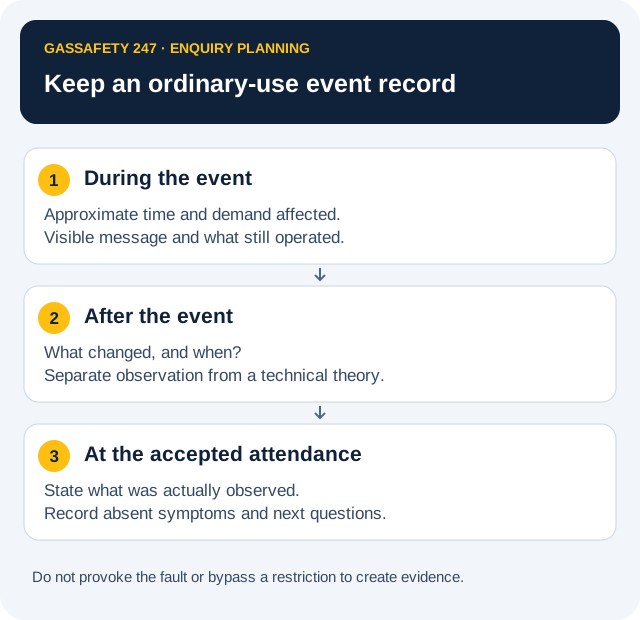
Record the approximate date, demand being used, visible display and effect on heating or hot water. If the boiler resumed operation, note when that happened and distinguish an automatic change from a documented professional intervention. Use an ordinary-use log rather than perform experiments to force recurrence. A missing timestamp can be described as approximate; an owner should not invent precise data to make the record look authoritative. The aim is a reliable pattern the provider can assess, with customer observations kept separate from the technical conclusion.
Preserve meaningful differences between events
A morning loss of hot water and an evening heating interruption may be part of one concern or separate issues. Describe them individually rather than group every inconvenience under intermittent boiler failure. Note whether the same demand and message were involved, and supply any earlier report identifying a connection. The professional should decide how those observations inform the investigation. The purchase becomes more useful when the enquiry retains differences instead of forcing all events to fit an assumed valve, board or sensor defect before the installation has been assessed.
Avoid treating a suspected association as an established cause
Customers may notice events after a period of inactivity, during particular household use or following another intervention. Report that association accurately, including occasions when the suspected trigger did not produce the symptom if you already know them. Do not change the installation or reproduce the event to prove a theory. A repeated sequence is helpful evidence but does not establish causation by itself. The accepted investigation should explain which questions it can address and which remain open rather than sell a corrective component solely from the customer's proposed explanation.
02
Commission a visit that acknowledges the symptom may be absent
Establish what can be assessed under the conditions actually present
Ask the provider to define the initial work for the identified model and current condition. A routine appointment may permit useful assessment without reproducing the reported event, but the handover must distinguish observed findings from unverified historical symptoms. Neither a currently working appliance nor a brief normal operation period establishes that the concern was resolved. The accepted scope should make this limitation explicit before charging for an investigation whose success the customer interprets as guaranteed reproduction or exclusion of every intermittent malfunction.
Discuss staged assessment rather than an unlimited monitoring promise
If further attendance or a separate monitoring approach is proposed, ask what question it addresses and what evidence would justify it. Do not assume that GasSafety 247 offers a continuous remote-monitoring service or a product-specific logging device; acceptance must be confirmed for the actual work. Agree time and cost boundaries for each stage. A defined follow-up can be commercially useful where the first visit narrows a question, while an open-ended promise to keep returning until something happens leaves the owner unable to understand or authorise expenditure.
Keep code interpretation within the event chronology
Where a message appears only during the problem, keep its photograph with the relevant event rather than treat it as the present screen. Use boiler error-code diagnosis for the interpretation context. The exact product, message and operating demand must remain linked. If different messages occur, retain their sequence and any periods of normal use instead of reducing the enquiry to one favoured code. The investigation can then consider the reported pattern without turning a historic message into proof of one component failure.
03
Distinguish recurring faults from recurring purchasing assumptions
Review earlier replacements against the outcome they were intended to change
Supply the original finding, accepted repair and what you observed afterwards. A temporary improvement may be useful history, but it is not automatically proof that the replaced part was the only cause or that the earlier work was defective. Where several components were changed, preserve their dates and scope separately. The next assessment should not become another replacement based solely on the latest guess. The recurring-breakdown route provides the connected repair context when repeated corrective interventions are central to the enquiry.
Identify changes outside the appliance between observations
Tell the provider about documented control work, a change in hot-water arrangement or other connected-system intervention that occurred during the history. State what is known without blaming the new equipment automatically. A household may also change occupancy or its routine, making ordinary use different from the earlier period. These facts help define the assessment boundary rather than prescribe a cause. Ask whether connected equipment is within the accepted investigation and which additional task would require a separate proposal or another competent trade.
Define the point at which a part proposal is supported
Request an explanation of the finding behind a recommended intervention, including uncertainty where the original symptom was not observed. The customer needs enough context to distinguish an established defect, a further assessment proposal and an option whose outcome remains uncertain. Ask how materials, corrective labour and return attendance are priced. The investigation charge should not silently authorise a series of speculative replacements. Use pre-repair diagnosis when approval must wait for the written result and a separately accepted corrective proposal.
04
Coordinate a workable investigation at the occupied property
Keep the occupier's observations connected to the purchaser
Where a tenant sees the fault and an agent orders work, arrange a factual event summary that reaches the provider with the instruction. Identify the report recipient and remote decision contact. The person admitting the engineer should understand whether they can approve extra expenditure. Avoid asking the occupier to create an unsafe demonstration or keep a perfect technical diary as a condition of reporting a genuine problem. The provider can request appropriate ordinary information while the responsible purchaser defines the work and approval boundary.
Preserve restrictions even when the appliance resumes operation
A boiler returning to operation does not cancel a professional instruction restricting use. Send any such instruction before accepting attendance and follow the appropriate advice. HSE's domestic guidance underlines the role of competent professional attention to gas-appliance safety. Do not repeatedly reset, bypass controls or deliberately recreate the event. The investigation must work with the actual safety context rather than use a currently normal screen to disregard a warning or delay the appropriate urgent response to a suspected unsafe condition.
State practical access constraints without promising reproduction
Explain the periods when access is possible and any known association with ordinary household demand. The provider can confirm whether the proposed attendance is workable; it cannot guarantee the symptom will appear in that window. Describe locked cupboards, shared access and care-related interruption constraints. GasSafety 247 is based in Nottingham, while surrounding attendance needs postcode and equipment confirmation. An area listing does not establish an assigned engineer, continuous observation of the property or availability whenever an irregular event happens.
05
Make uncertainty and follow-up part of the recorded outcome
Request a clear account of what the visit did establish
Ask the record to identify the appliance, evidence supplied, findings observed and any limitation. If the reported event was not reproduced, it should remain described as unverified at that attendance rather than erased from the history. The result should explain the next question and why additional work is advised. A confident but unsupported diagnosis can create another unnecessary purchase; an explained result helps the owner decide whether to accept correction, provide ordinary follow-up evidence or commission a further defined assessment.
Keep the next instruction linked to the original investigation
Retain the report, event history and accepted follow-up together. If the symptom returns, describe whether it is the same event and send the existing record rather than start with an unrelated part request. The diagnostics hub provides the service parent and the Nottingham diagnostics cluster supplies the primary geographic relationship. Request a scope and charge for the next accepted stage. The objective is a traceable investigation and purchasing decision, not an unlimited guarantee that every sporadic event can be eliminated immediately.
Questions about intermittent boiler fault investigation in Nottingham
Can an investigation be useful when the boiler is working at attendance?
It may establish relevant findings within the accepted scope, but it cannot pretend the reported event was observed if it was absent. Ask the provider to distinguish current assessment, historical evidence and remaining uncertainty in the written result.
How detailed should an ordinary-use event log be?
Include approximate timing, the demand affected, visible information and what changed afterwards. Mark uncertain details as uncertain. The log supports the professional enquiry without requiring the customer to diagnose components, create precise data retrospectively or conduct technical experiments.
Should I include times when a suspected trigger caused no fault?
If you already have that ordinary observation, it can help describe the pattern more honestly. Do not perform additional tests to manufacture a comparison. An association should remain evidence to assess rather than a concluded cause selected before the visit.
Does normal operation for a few days prove the repair solved everything?
Not by itself. State the observation period and whether the earlier symptom returned. The professional can explain what the repair and follow-up actually establish. A brief improvement must not be expanded into an unlimited guarantee of future reliability.
What if different messages appear during separate events?
Keep the sequence, model and function affected linked to each event. A single abbreviated code may lose the useful chronology. The provider should interpret the evidence for the actual product rather than assume each message means the same failed component.
Can I choose a visit at the hour when the problem usually occurs?
Give the observed pattern and practical access window for consideration. Actual attendance needs confirmation, and recurrence cannot be guaranteed. The accepted proposal should explain what assessment is possible if the symptom does not occur during that period.
Is continuous remote monitoring included in a diagnostic appointment?
No monitoring capability is assumed here. Ask whether any defined follow-up approach can be accepted for your appliance and what it would establish. A routine visit should not be read as an ongoing remote service or unlimited return-attendance contract.
Should a tenant keep resetting the boiler to gather evidence?
No. Retain ordinary observations and professional advice without repeatedly restarting or overriding restrictions. The investigation should decide the appropriate assessment method. The purchaser should not require a hazardous demonstration to take an occupier's reported concern seriously.
Can an earlier replacement guide the next investigation?
Send its supporting finding, date and scope along with the subsequent outcome. That chronology can inform the enquiry, but should not automatically endorse or reject the previous remedy. The new assessment must address the actual current question and evidence.
Are multiple speculative parts included under the initial charge?
Do not infer that. Ask how further assessment and any supported corrective proposal will be authorised and priced. An investigation fee should not silently become an allowance for repeated component changes without an explained finding or financial approval.
What if the symptom stopped before I could photograph the display?
Report what you remember and identify any uncertainty. Lack of a photograph does not require inventing a message or denying the event. The provider can define the accepted assessment using the evidence genuinely available.
Should changes to heating controls be disclosed?
Yes, provide documented work and when the behaviour changed. The provider can decide whether connected-equipment assessment is appropriate. The timing of a control replacement is useful context rather than proof that it caused or resolved an intermittent appliance fault.
Can two different household problems belong to one investigation?
Describe them separately and ask whether the proposed scope addresses both. The professional should determine their relationship. Combining unrelated events into one assumed cause can make the instruction and eventual repair proposal less accurate.
What record is useful after a visit that does not reproduce the fault?
Ask for the work completed, findings, historical evidence considered and unverified questions to be stated. A limited result can support a sensible next instruction. It should not describe the concern as eliminated solely because operation was normal during attendance.
Does another appointment cancel an existing restriction on use?
No. Keep the professional instruction in force and disclose it to the provider. The accepted task must address that safety context. A booking, returned heating or clear display is not an independent reason to disregard the restriction.
How should further attendance be approved?
Request the question it will address, expected deliverable and separate charge before accepting it. Name the decision contact. Defined stages let the owner understand expenditure; an open-ended promise to keep investigating has no clear purchasing boundary.
Can the investigation decide a previous contractor's guarantee dispute?
It does not automatically determine another contract or liability. Retain the earlier documents and contact the guarantee issuer about its terms. The new task can record current findings without pretending to adjudicate every earlier intervention.
Should a recurrence after follow-up start a completely new file?
Keep it with the same appliance history and identify whether the event matches earlier observations. Send the previous report and accepted work outcome. That continuity helps define the next task without treating each recurrence as an unrelated part request.
Does a listed surrounding area provide an on-call observer for irregular faults?
No such arrangement is established. The business is based in Nottingham and confirms actual scope and attendance for each enquiry. A target-area page does not create a local branch, monitoring contract or engineer stationed at the property.
How do I request an intermittent investigation with realistic scope?
Send the event history, current model, earlier findings and access constraints through Contact. Ask what can be assessed now, what remains uncertain and how any follow-up or corrective stage will be priced and authorised before booking.
Speak directly with GasSafety 247
Need intermittent boiler fault investigation?
Send the postcode, appliance information and the symptoms or planned work to GasSafety 247.

 Check the ID card